addis-fortune-finance

Our Social Network

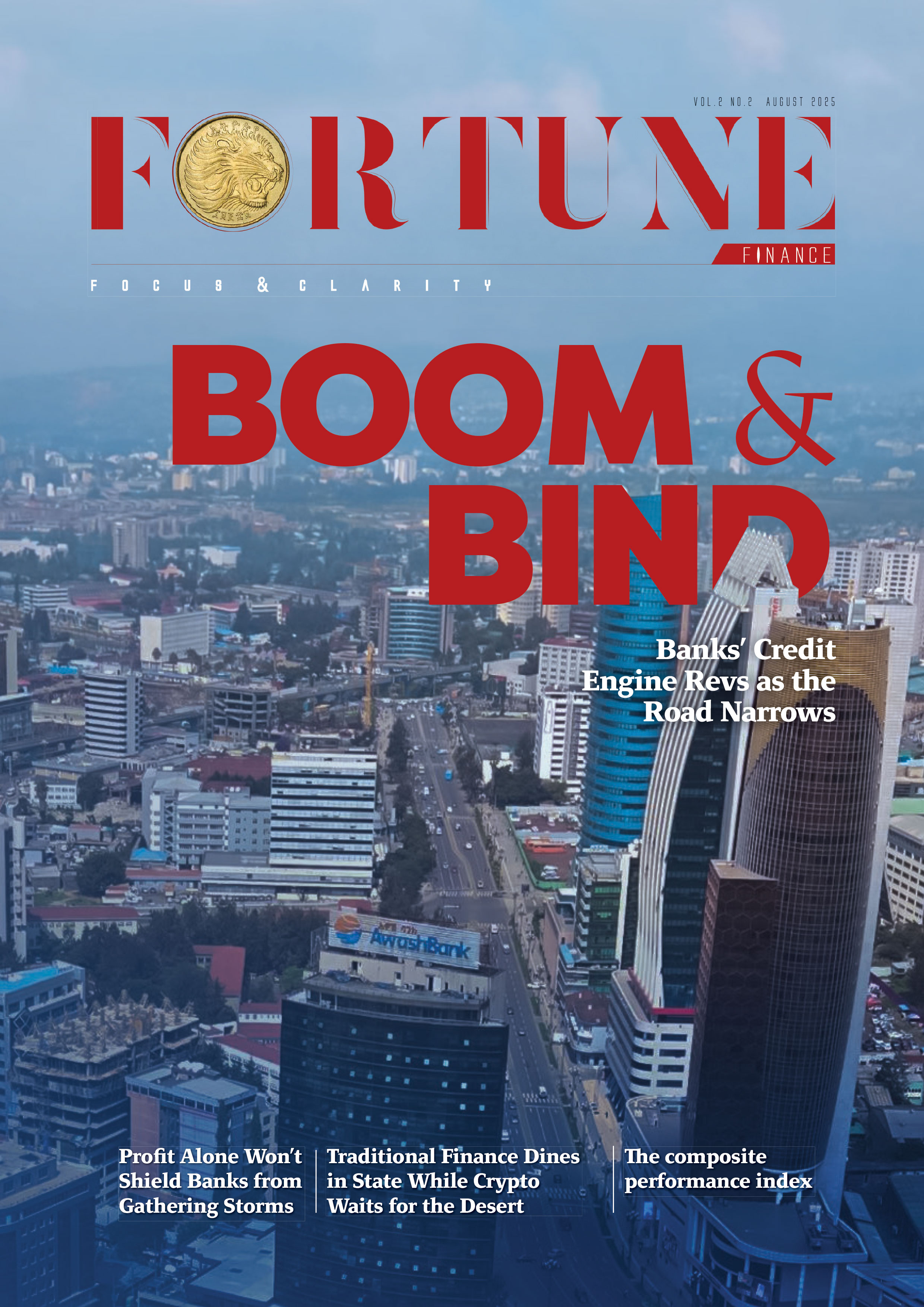
Boom & Bind
Banks’ Credit Engine Revs as the Road Narrows

The banking industry entered the current financial year both sturdy and unsettled. Profits were strong, loan books looked clean and capital buffers respectable. Yet, shallow financial depth, stubborn inflation, and heavy government exposure to budget deficit darkened the horizon. The credit engine w...

The banking industry entered the current financial year both sturdy and unsettled. Profits were strong, loan books looked clean and capital buffers respectable. Yet, shallow financial depth, stubborn inflation, and heavy government exposure to budget deficit darkened the horizon. The credit engine was revving; whether it powers growth or overheats would depend on deft regulation, disciplined fiscal policy, and the banks’ ability to adapt faster than risks accumulate. 

Commercial banks survived the financial year 2023/24 with their engines roaring and warning lights glowing on the dash. Their profits were cushioned by growing capital, at least on paper, several edging to the regulatory bar set for next year. 

However, the industry is hurtling down a narrow and uneven road. Credit reached only a slice of the economy, inflation eats away at real returns and the government’s heavy borrowing ties lenders ever more tightly to public sector fortunes.

Inside the humid boardrooms on Ras Abebe Aregay St., in a district a.k.a the Wall Street of Addis Abeba, executives leaf through spreadsheets that chart a dramatic climb. A system that three decades ago was little more than a state storefront now counts 32 financial institutions shepherding trillions of Birr in assets and close to 100 million deposit accounts.

The industry’s assets of 3.28 trillion Br at the end of June 2024, was up 15pc in a year and equal to almost 30pc of gross domestic product. Deposits reached 2.5 trillion Br, while outstanding loans and bonds topped 2.2 trillion Br.

The heft is concentrated. The state owned Commercial Bank of Ethiopia (CBE) alone holds 48pc of assets and 47pc of deposits, massed that anchors the system but also pins its stability to one institution. At the other extreme is another state-owned policy bank, the Development Bank of Ethiopia (DBE). It was saddled with a development mandate, non performing loans (NPLs) above 30pc. 

Even after the recent growth spurt, the financial depth remains thin. Domestic credit to the private sector sat near 18pc of GDP, well below Kenya’s 32pc and South Africa’s 68pc. Formal finance funded less than one-fifth of output even after a decade long branch building drive that produced 12,426 outlets by June 2024 and cut the population to branch ratio to roughly one to 8,800.

Age explains part of the gap. Fourteen of today’s 30 private commercial banks were licensed after 2019. They are sprinting from a standing start. Amhara Bank opened 542 branches in two years and tripled deposits to 52 billion Br; Goh Betoch and Ahadu banks followed a similar trajectory but remained in the red. Assets at newcomer Tsehay Bank ballooned more than 300pc last year, yet its return on assets barely scraped 0.8pc. 

However, branch expansion has reshaped access to money. Deposit growth fuels loan growth that ran at 22pc in 2023/24, more than twice the pace of nominal GDP. Net interest income still did the heavy lifting, providing roughly 75pc of revenue. Staff costs absorbed an average 45pc of expenses, interest 30pc, and administration 15pc.

Fees, driven by mobile wallets, agency banking, and diaspora remittances, contributed the remaining quarter, a slice that was growing fast. 

Industry net profit before tax exceeded 30 billion Br last year, an 18pc margin that translated to an average 1.9pc return on assets (RoA). Behind the average lies a gulf. CBE and private sector pioneer Awash each delivered returns around two percent, while efficiency specialist Zemen Bank topped three percent. A dozen new or interest free banks logged RoAs below 0.5pc and in some cases outright losses as they poured money into bricks, mortar, and marketing. 

The leaders are easy to spot. CBE, with 1.1 trillion Br in assets, earned about 20 billion Br — roughly a 30pc margin — while keeping its loan to asset ratio near 50pc and its loan to deposit ratio close to 80pc. Awash Bank posted almost seven billion Birr in net profit, a 25pc margin, and 2.8pc RoA; its leaner cost base delivered about 580,000 Br of profit for every employee and 270 million Br of deposits a branch.

Dashen and Abyssinia banks follow with net margins of 22pc and 17pc, respectively, and RoAs near 2.5pc. Zemen, though smaller, punches above its weight with a 30pc margin, 3.5pc RoA and deposit productivity north of 400 million Br a branch. 

A broad middle — 10 banks including Nib International, Hibret, Wegagen, Cooperative Bank of Oromia and Lion — clustered around margins in the high teens and returns between 1.5pc and 2.2pc. Assets and deposits at these lenders grew 20pc to 30pc a year, in line with the market, but cost ratios often topped 60pc of income. 

Non performing loans average a manageable three percent to four percent and provisioning a skimpy one percent to two percent of gross loans.

At the tail sat the newcomers. Amhara Bank’s ended slightly in the red in its first operational year in 2022/23, although recovered into the profit zone the following year. Siinqee, Tsehay and a quartet of interest free lenders, such as ZamZam, Hijra, Shabelle and Rammis, earned meager profits or small losses while their assets and deposits leapt more than 200pc. 

Performance matters beyond the boardroom politics. Credit growth is oxygen for private investment; last year, the banks lent at more than twice the pace of GDP. At the same time, the Treasury leans on banks to plug the budget gap.

Lenders held almost 400 billion Br in government securities, about four percent of GDP. Although these holdings now account for roughly one-fifth of total banking assets, capital offered some comfort. 

The industry’s total equity neared 296 billion Br, about nine percent of assets and a shade above Basel’s eight percent floor. New banks such as Siinqee and Tsedey carried buffers north of 30pc. Yet, leverage was creeping. Awash, Abyssinia and CBE run asset to equity multiples of 15 plus. In a downturn, those thin slices of loss absorbing capital could vanish fast.

The system wide NPL ratio sliding to 3.6pc last year, asset quality looked benign for now. Its best mark in half a decade; provision charges averaged 1.5pc of loan books. The outlier remains the DBE. 

Inflation, stuck close to 20pc year-on-year (YoY) last year, threatened those numbers on two fronts. It eroded real margins for savers and lenders while squeezing borrowers whose costs rise faster than capped lending rates. A regulatory ceiling pinned deposit rates at seven percent, a spread that fattened bank profits today but could spark a backlash if savers tire of negative real yields.

Liquidity appears ample — the industry loan to deposit ratio wass 88pc — but stress lurks beneath the surface. Abyssinia advanced 92pc of deposits, while ZamZam deployed barely a third. A shallow interbank market pushed over stretched lenders toward overnight lines from CBE. 

Federal authorities announced a deposit insurance scheme in 2021. However, it remains on the drawing board and under funded.

The digital expansion brings promise and peril. Telebirr notched its 40 millionth user in March, and Dashen bank owned wallet Amole processed an estimated 320 billion Br last year, lifting fee income and trimming cash handling costs. A mid tier lender can now buy a 200,000 dollar server cluster that does the work of 50 branches. But each new channel widens the attack surface. 

Cyber fraud incidents are climbing worldwide, and Ethiopian banks are compelled to harden defenses fast.

The swelling pile of government paper ties bank fortunes more tightly to fiscal policy. A debt restructuring or spike in yields would slice into earnings and eat at capital. The National Bank’s credit ceilings, designed to curb inflation, sometimes pushed healthy borrowers toward off balance sheet financing, a shift that could haunt lenders if macro conditions stall. 

External pressures are building. The Birr’s managed float, launched last August under a 3.4 billion dollar International Monetary Fund (IMF) program, narrowed the parallel market premium but devalued the currency by about 170pc. A further slide would inflate Birr’s value of banks’ foreign currency assets yet could inflate import bills and knock borrowers’ repayment capacity.

Capital market reforms are stirring. In March, the Ethiopian Capital Market Authority (ECMA) issued the first two investment banking licenses, to arms of CBE and Wegagen Bank. A domestic securities exchange is set to open this year. Over time, that could offer companies an alternative to bank loans and supply banks with new funding channels, though markets of that sort take years to deepen. 

The banking industry could double again if loans and deposits keep growing 15pc to 20pc a year. In a rosy scenario, inflation cools, exports rise and GDP growth tops six percent, lifting credit to GDP past 30pc and trimming the cost to income ratio to about 45pc. In a tougher world, currency weakness and fiscal strain keep liquidity tight, compress spreads, and drag returns below 1.5pc, forcing thinly capitalised newcomers into mergers.

Regulators are unlikely to leave the outcome to chance. Analysts expect the Central Bank to raise the capital to asset minimum to 10pc and impose a counter cyclical buffer. Banks that raise equity early will gain both resilience and market share when the next shock hits. Foreign competition looms as well, bringing cheaper funding and narrower spreads. 

Technology may tip the balance, with software rather than bricks sorting winners from laggards. The same tools will sharpen credit scoring, widen reach through agents, and cut fraud losses, if banks learn to wield them.

The banking industry has traveled a remarkable distance in short order, shifting from a state led apparatus to a crowded and fast growing marketplace. The boardrooms on Ras Abebe Aregay St. now hum with real competition. Executives know the margin for error has narrowed. Regulation will tighten and foreign rivals will arrive and inflation will not wait. 

 The industry’s credit engine is revving hard, but the clutch is delicate. Too much acceleration without fresh capital could overheat the system, and too little lending could stall the recovery.

Download Vol. 2 For Free

Experience the full story in our exclusive digital edition. Addis Fortune Finance – Volume 2 takes you inside the defining moments of Ethiopia’s banking year. From record-breaking profits to emerging risks, this issue offers in-depth analysis, data-driven insights, and expert commentary.

Addis fortune Finance

© 2024 - 2026 Independent News & Media PLC All Rights Reserved.